
Overview
Choosing the right learning environment for your child is one of the most important decisions you’ll ever make as a parent. If you’ve been researching alternatives to traditional schooling, you’ve almost certainly come across the word Montessori. Maybe a friend’s child attends a Montessori school. Maybe you’ve seen those beautiful wooden toys on Instagram. Maybe you typed “montessori schools near me” into Google and ended up overwhelmed by the sheer number of options.
This guide is designed to clear up the confusion. By the end of this article, you’ll understand exactly what Montessori education is, where it came from, how a Montessori school actually works on a daily basis, what those famous materials do, and — most importantly — whether this approach is the right fit for your child.
Let’s dive in.
What is Montessori Education?
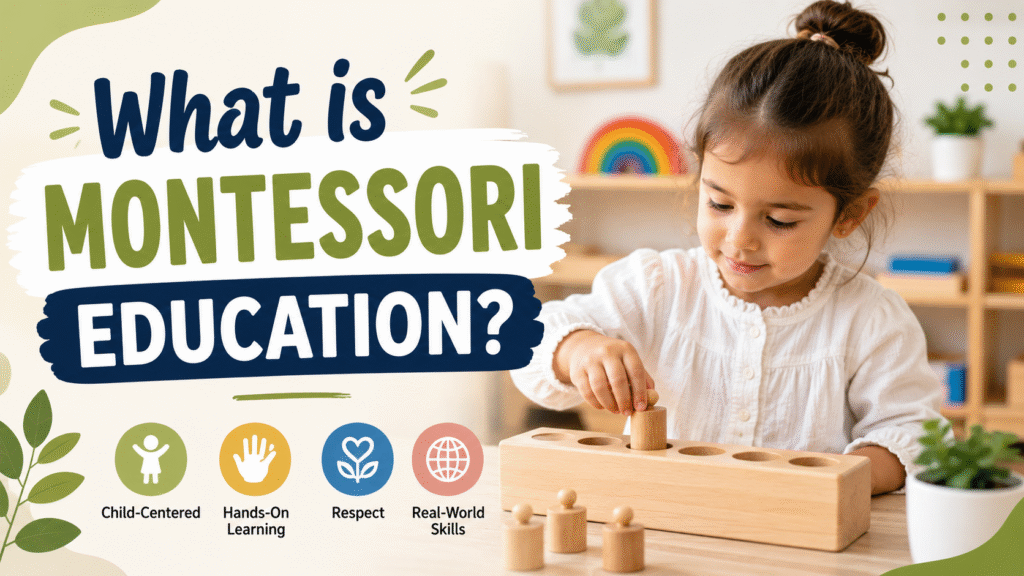
Montessori education is a child-centered educational approach developed by Italian physician and educator Dr. Maria Montessori in the early 1900s. Unlike conventional classrooms where every child is expected to learn the same thing at the same time in the same way, Montessori is built around a radical idea: children learn best when they’re allowed to choose meaningful work in a thoughtfully prepared environment, at their own pace, with gentle guidance from trained adults.
It’s not a curriculum in the rigid sense — it’s an entire educational philosophy. The Montessori method respects the child as an individual with unique interests, developmental needs, and an innate drive to learn. The teacher’s job isn’t to “fill” children with information. It’s to observe, guide, and remove obstacles between the child and their natural curiosity.
Today, there are over 20,000 Montessori schools worldwide, serving children from birth through age 18. The method has stood the test of time for one simple reason: it works.
A Brief History: Who Was Maria Montessori?
To understand Montessori education, it helps to understand its founder.
Dr. Maria Montessori was a pioneer in every sense. Born in 1870, she became one of the first female physicians in Italy at a time when medicine was almost exclusively a man’s world. Her early work with children who had developmental challenges led her to a startling realization: many of these children weren’t lacking intelligence — they were lacking the right environment and the right tools to express what they already knew.
In 1907, she opened her first school in a poor district of Rome, calling it Casa dei Bambini (“Children’s House”). What happened there changed education forever. Given freedom of movement, beautiful hands-on materials, and respect from adults, children as young as three were teaching themselves to read, write, and do mathematics — often surpassing children in conventional schools.
Word spread quickly. By the 1920s, Montessori schools were opening across Europe, India, and the Americas. Maria Montessori was nominated for the Nobel Peace Prize three times and dedicated her entire life to understanding how children actually learn. Her books — The Absorbent Mind, The Discovery of the Child, The Secret of Childhood — remain required reading for educators around the world.
The Core Principles of the Montessori Method
Every Montessori school, whether in Kolkata, California, or Copenhagen, is built on a foundation of shared principles. Here are the ones that matter most.
1. The Prepared Environment
A Montessori classroom doesn’t look like a typical classroom. There are no rows of desks. No giant teacher’s table at the front. Instead, you’ll see low, open shelves with carefully arranged materials. Child-sized furniture. Plants. Natural light. Real glassware (yes, even with toddlers).
This is called the prepared environment, and every single object in it has been thoughtfully placed by the guide. The space invites independence — a child can reach what they need, return it when finished, and choose what comes next without an adult’s help.
2. Child-Led Learning
In a Montessori classroom, children choose their own work. This isn’t chaos — it’s freedom within limits. A child might spend forty-five minutes pouring water between pitchers, building the Pink Tower, or working through a math problem with the golden beads. They follow their interest, and because they chose the activity themselves, their concentration is deep and genuine.
This approach taps into what Maria Montessori called sensitive periods — windows of time when a child is biologically primed to absorb a particular skill, whether language, order, movement, or small details.
3. Mixed-Age Classrooms
Montessori classrooms group children in three-year age spans: 0–3, 3–6, 6–9, 9–12, and so on. This isn’t an accident.
Younger children learn by watching older ones. Older children solidify their knowledge by teaching the younger ones. The community feels more like a family than a class, and competition is replaced by collaboration. There’s no “top of the class” because there’s no class to be at the top of.
4. The Three-Hour Work Cycle
Most Montessori classrooms run on an uninterrupted three-hour work period. No bells. No abrupt transitions. Children have the time to enter a state of deep concentration — what Montessorians call normalization — without being pulled away every twenty minutes.
This is one of the biggest differences from traditional school, and it produces remarkable focus.
5. The Role of the Montessori Guide
You’ll notice we keep saying “guide” instead of “teacher.” That’s intentional. A Montessori guide doesn’t stand at the front of the room delivering lessons. They observe each child, give individual or small-group presentations on new materials, and step back to let the child do the actual work.
Trained Montessori guides typically hold a diploma from one of two main organizations: AMI (Association Montessori Internationale), founded by Maria Montessori herself, or AMS (American Montessori Society). Both produce excellent educators, though their training philosophies differ slightly.
6. Respect for the Child
This is perhaps the most powerful principle of all. Montessori adults speak to children as full human beings — at eye level, with calm voices, without baby talk, without commands shouted across the room. Children are trusted with real responsibilities: real knives in the kitchen, real glass at snack time, real consequences for their choices.
The result? Children rise to meet the respect they’re shown.
Montessori vs. Traditional Education: What’s the Real Difference?
It helps to see the contrast laid out plainly.
| Traditional Education | Montessori Education |
|---|---|
| Teacher-led instruction | Child-led, self-directed work |
| Same-age classmates | Mixed-age classrooms (3-year spans) |
| Fixed curriculum and timetable | Individualized pace and interests |
| Desks in rows facing front | Open floor plan with workspaces and rugs |
| Rewards, stars, grades | Intrinsic motivation and self-assessment |
| Short class periods with bells | Uninterrupted 3-hour work cycle |
| Memorization and worksheets | Concrete, hands-on materials |
| Whole-class lessons | One-on-one or small-group presentations |
Neither approach is “right” or “wrong” for every child — but the differences are real, and they shape how a child experiences school every single day.
The Five Areas of a Montessori Classroom
If you walk into a primary Montessori classroom (ages 3–6), you’ll see the room divided into five distinct learning areas. Each one targets a different aspect of the child’s development.
1. Practical Life
This is where it all begins. Pouring, scooping, sweeping, buttoning, polishing shoes, arranging flowers, washing tables, preparing snacks. These activities look simple, but they build concentration, coordination, independence, and a sense of order — the foundation for all later academic work.
For many parents, this is the surprise of Montessori. Why is my four-year-old learning to fold napkins? Because that small, repeated act of care builds the focus they’ll later use to learn algebra.
2. Sensorial
Sensorial materials are designed to sharpen the senses and help children classify the world around them. The famous Pink Tower (ten graduated pink cubes) teaches visual discrimination of size. The Brown Stair, the Red Rods, the Color Tablets, the Sound Cylinders, the Smelling Bottles, the Geometric Solids — each isolates one quality (size, color, sound, weight, shape) so the child can study it without distraction.
This isn’t just play. It’s preparation for mathematics, geometry, music, art, and scientific observation.
3. Language
Montessori language work moves from concrete to abstract beautifully. Children begin with Sandpaper Letters — running their fingers over the shapes of letters while saying their sounds (not their names). They move to the Movable Alphabet, where they can build words long before they can physically write them. By age four or five, many Montessori children are reading fluently and writing their own stories.
Vocabulary cards, grammar boxes, and story sequences continue the work as children grow.
4. Mathematics
Math is where Montessori truly shines. Abstract concepts are made concrete with stunning clarity. The Number Rods show quantity. The Spindle Boxes teach zero. The Golden Bead Material — beads, bars, hundred squares, and thousand cubes — lets a five-year-old physically hold a thousand in their hands and perform four-digit addition with carrying.
Children don’t memorize times tables in Montessori. They build understanding of what multiplication actually is — and then the memorization happens almost as a byproduct.
5. Cultural Studies
The cultural area covers geography, history, biology, botany, zoology, science, art, and music. Children learn about continents through sandpaper globes and puzzle maps. They study the parts of a flower, the life cycle of a frog, the timeline of human history.
The goal is what Montessori called “cosmic education” — helping children see how everything in the universe is connected, and how they themselves fit into the larger story of life on Earth.
Famous Montessori Materials and What They Teach
Montessori materials are works of art — but more importantly, they’re carefully engineered to teach one concept at a time, with a built-in control of error so the child can correct themselves without an adult pointing out mistakes.
Here are some of the most iconic:
- Pink Tower — visual discrimination of size; preparation for math and geometry
- Brown Stair — discrimination of width; preparation for the decimal system
- Knobbed Cylinders — visual and tactile size discrimination; pincer grip for writing
- Sandpaper Letters — phonetic sounds and the motor memory of letter shapes
- Movable Alphabet — early word building and writing before handwriting develops
- Number Rods — quantity and counting
- Sandpaper Numerals — symbol recognition for numbers 0–9
- Golden Bead Material — the decimal system; addition, subtraction, multiplication, division
- Stamp Game — abstract math operations
- Binomial and Trinomial Cubes — sensorial preparation for algebra
- Puzzle Maps — geography of the continents and countries
- Constructive Triangles — the building blocks of all plane geometry
Each material is beautiful, made of natural wood and other quality materials, and designed to invite the child to engage.
Montessori Across the Stages: From Infant to Adolescent
Montessori education isn’t just for preschoolers. The method spans the entire developmental arc.
Infant & Toddler (0–3 years)
Focus is on movement, language, independence, and order. Low beds, child-sized furniture, real tools, and lots of language input. Toddlers learn to dress themselves, prepare simple snacks, and care for their environment.
Primary / Casa (3–6 years)
The classic Montessori classroom. The five areas (Practical Life, Sensorial, Language, Math, Cultural) come into full bloom. Most children leave Primary reading, writing, and doing basic math.
Lower Elementary (6–9 years)
The child’s imagination explodes. Montessori introduces the Great Lessons — sweeping, dramatic stories about the formation of the universe, the coming of life, the rise of humans, the story of language, and the story of numbers. Children pursue deep research projects.
Upper Elementary (9–12 years)
Abstract thinking emerges. Children take on more responsibility for their own learning plans, go on “Going Out” trips into the community, and tackle increasingly sophisticated work.
Adolescent (12–18 years)
Montessori adolescents often work on farms, run small businesses, and engage in meaningful community work — all while continuing rigorous academics. The focus shifts to identity, contribution, and finding one’s place in society.
The Benefits of Montessori Education
Research and decades of parent experience point to a remarkable set of outcomes for Montessori children.
Independence and self-confidence. Because they’ve been doing things for themselves since they were two, Montessori children develop a quiet, grounded confidence that lasts a lifetime.
Deep concentration. The three-hour work cycle builds focus muscles that conventional school often weakens.
Intrinsic motivation. Without grades, stickers, or punishments, children learn because they want to. This love of learning carries into adulthood.
Strong social skills. Mixed-age classrooms turn children into mentors and collaborators rather than competitors.
Critical thinking. Hands-on learning with concrete materials builds genuine understanding, not just memorization.
Self-discipline. Children learn to manage their own time, choose their own work, and complete it without being told.
Respect for self and others. The culture of respect modeled by Montessori guides becomes the child’s natural way of being in the world.
Notable Montessori alumni include the founders of Google (Larry Page and Sergey Brin), Amazon’s Jeff Bezos, Wikipedia’s Jimmy Wales, and Nobel laureate Gabriel García Márquez — all of whom have credited their Montessori experience with their ability to think independently and creatively.
Common Myths About Montessori (And the Truth)
Myth: Montessori is just for rich families. Truth: While many Montessori schools are private and tuition can be significant, there are also public Montessori programs around the world. And the principles of Montessori parenting can be applied at home for free.
Myth: Montessori children can do whatever they want. Truth: It’s freedom within limits. Children choose their work from prepared options, follow clear ground rules, and respect the rights of others. It’s not a free-for-all.
Myth: Montessori is anti-technology. Truth: Younger Montessori environments do minimize screens, but elementary and adolescent programs increasingly integrate appropriate technology as a tool for research and creation.
Myth: Montessori children struggle when they enter “regular” school. Truth: Studies consistently show Montessori children transition well — and often outperform peers in independence, problem-solving, and creativity.
Myth: It’s a religion or a cult. Truth: Montessori is a scientific, secular educational method. Many religious families love it, but it has no religious affiliation.
How to Find the Right Montessori School Near You
When parents search for “montessori schools near me,” they often discover that the word “Montessori” isn’t trademarked. Any school can call itself Montessori, regardless of whether it actually follows the method. This makes school selection critical.
Here’s what to look for:
1. Check for Accreditation
Look for schools accredited or affiliated with AMI (Association Montessori Internationale) or AMS (American Montessori Society). These are the gold standards. Other reputable bodies include IMC (International Montessori Council) and MEPI.
2. Ask About Teacher Training
Are the lead guides AMI or AMS trained for the specific age group they teach? A 0–3 diploma is different from a 3–6 diploma. Authentic training takes 1–2 years of intensive study.
3. Observe a Classroom
Any quality Montessori school will let you observe. Look for:
- A calm, busy atmosphere with children deeply engaged in chosen work
- A wide range of authentic Montessori materials, in good condition
- Mixed-age groupings (3-year spans)
- A three-hour uninterrupted work cycle in the morning
- Guides moving quietly between children, giving individual lessons
If you see rows of desks, whole-class lessons, plastic toys, or worksheets being handed out — that’s not authentic Montessori.
4. Questions to Ask the Director
- How long has the school been operating?
- What is the teacher-to-child ratio?
- Are classrooms truly mixed-age?
- How do you handle discipline?
- How do you communicate with parents?
- What’s your philosophy on screens, homework, and outdoor play?
5. Trust Your Instincts
Visit. Watch your child interact with the environment. Talk to current parents. The right school will feel right.
Is Montessori Right for Your Child?
The honest answer: Montessori works beautifully for most children, but the fit between family values and school philosophy matters.
Montessori tends to be a strong fit when:
- You value independence and want your child to develop self-direction
- You’re comfortable with a less structured, less “performance-driven” approach in the early years
- You respect your child as a capable individual
- You’re willing to extend Montessori principles at home (low shelves, real responsibilities, calm communication)
It may be a more challenging fit if you want daily worksheets coming home, regular grades and rankings, or a heavily academic preschool experience focused on testing.
Most families who choose Montessori report that the decision changed not just their child’s education, but their entire approach to parenting.
Final Thoughts
Montessori education isn’t a trend. It’s a hundred-year-old, scientifically grounded approach to helping children become exactly who they were born to be — independent, curious, kind, capable human beings.
If you’re considering Montessori for your child, the best next step is simple: visit a school. Sit in a classroom for an hour. Watch the children. Watch the guides. Feel the calm.
You’ll know.
Education is one of the greatest gifts a parent can give. Choosing an approach that respects your child’s natural development, builds genuine independence, and ignites a lifelong love of learning may be the most powerful investment you ever make. Whatever you decide, the fact that you’re asking these questions already says you’re the kind of parent who’s putting in the work.
And that, more than anything, is what your child needs.